Open Letter from Assata: I am a 20th Century Escaped Slave

originally published in CounterPunch

Please take the time to read and spread this open letter to the media from Assata Shakur, exiled former Panther in Cuba.  Assata’s story is a perfect example of the racist injustice meted out by this government and its so-called law enforcement agencies.  I’m worried about our courageous sister, who has a $2 million bounty on her life, now that the U.S. has opened the door to Cuba.  Hands off Assata!!

I am a 20th Century Escaped Slave

by ASSATA SHAKUR

California Tells Court It Can’t Release Inmates Early Because It Would Lose Cheap Prison Labor

Out of California’s years-long litigation over reducing the population of prisons deemed unconstitutionally overcrowded by the U.S. Supreme Court in 2010, another obstacle to addressing the U.S. epidemic of mass incarceration has emerged: The utility of cheap prison labor.

Indictment of Ex-Official Raises Questions on Mississippi’s Private Prisons

JACKSON, Miss. — In 1982, Christopher B. Epps, a young schoolteacher, took a second job as a guard at the facility known as Parchman Farm, the only prison operated at the time by the Mississippi Department of Corrections.

Eventually he had to choose a path. “It worked out that I was making more as a correctional officer than as a teacher,” Mr. Epps would later recall in an interview for a corrections newsletter.

A Claim of Innocence Is No Longer a Roadblock to Parole

BEACON, N.Y. — After 28 years in prison, Freddie Cox emerged from the Fishkill Correctional Facility, not quite a free man, but free enough.

A sister had cued up Sam Cooke’s “A Change Is Gonna Come” on her car’s CD player, and, after hugs, Mr. Cox put his two small bags and his typewriter in the car and squeezed in alongside the others, heading away from prison, windows down.

Mr. Cox had been imprisoned for a 1986 murder in Coney Island, Brooklyn. He said then and he says now that he is innocent — and he has maintained that position at four parole hearings.


Former inmates released under Prop. 36 doing well, advocates say

Web developer Eddie Griffin just finished an internship at a tech company and is on the hunt for a new position. But his background sets him apart from many of Silicon Valley’s programmers.

Just over a year ago, the 58-year-old Richmond resident was in San Quentin State Prison, serving the 13th year of a 27-to-life prison sentence. He was given a second chance under Proposition 36, the 2012 measure that reformed the state’s “three strikes and you’re out” law, and appears to be making the most of it.

The Case for Closing Down Women's Prisons

It sounds like a radical idea. Stop incarcerating women, and close down women’s prisons. But in the UK, there is a growing movement, sponsored by a peer in the House of Lords, to do just that.

The argument is actually quite straightforward: there are many fewer women in prison than men to start with – women make up just 7% of the total prison population. This means that these women are disproportionately affected by a system designed for men.

Legal investigator training on October 25th

Join California Prison Focus and the Prisoner Hunger Strike Solidarity Coalition to investigate prison conditions in California’s supermax facilities

Saturday, October 25, 2014

11:30am – 3:30pm

1904 Franklin Street, 3rd floor conference room

Oakland, CA 94612

Snacks will be provided


Witness' dubious history puts a 16-year-old murder conviction in doubt

June Patti had a hunger to be heard.

A large woman with scarlet-dyed hair and a loud, raspy voice, Patti was a known drug addict who presented herself as a paralegal. Raised in the Redondo Beach area, she moved to northwest Washington state in the 1990s and soon became a local fixture, quick to phone law enforcement. One year she called 800 times, recalled Skagit County Sheriff Will Reichardt.

The Score: Why Prisons Thrive Even When Budgets Shrink

Who says the government can’t do anything anymore?

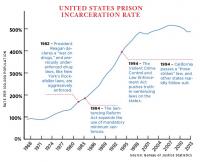
Even as Ronald Reagan argued that “government is the problem” throughout the 1980s, the state imprisoned twice the percentage of Americans previously incarcerated. As Bill Clinton declared “the era of big government” over in the 1990s, incarcerations skyrocketed to almost five times their rate in the 1970s—a rate that had been stable across the twentieth century. How did this happen?

Michael Anthony Kerr, Inmate With Schizophrenia, Died Of Thirst After 35 Days Of Solitary

RALEIGH, N.C. (AP) — A North Carolina inmate with mental illness who died of thirst was held in solitary confinement for 35 days and cited twice for flooding his cell, according to prison records.

Pages

Subscribe to Prison Activist Resource Center RSS